News
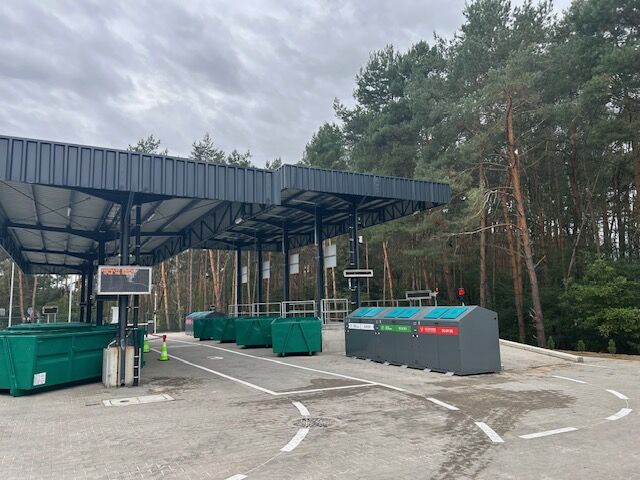
A recycling center that’s tailored to people’s daily lives—rather than the other way around.
On September 23, we attended the opening of the automated recycling center ePSZOK247 in Mateuszewo, in the municipality of Śrem, Poland. As the German partner and point of contact for T-MASTER SA, BAS familiarized itself with the on-site processes and contributed the German perspective to the international exchange.
The concept: self-service waste drop-off—designed for round-the-clock access. The system identifies users, guides them to the appropriate drop-off point, and records the quantities dropped off by weighing them. For municipalities and waste management companies, this is a concrete approach to combining user-friendliness with transparent processes.
Our colleague Andreas Baitz participated in the international panel discussion on local waste management structures and what makes the Polish solutions of interest to other countries.
Also participating were Stefan Marten from the city of Werder (Havel) and Simon Schmidt, managing director of MEBRA. Thank you very much for the discussion—and to T-Master for the insights into technology and practical application!
As the point of contact in Germany, we facilitate the dialogue with municipalities and waste management companies regarding T-Master’s solutions.
What would be the most important requirement for your municipality when it comes to an automated recycling center: easy access, clear user guidance, or tracking waste volumes?
Further Information
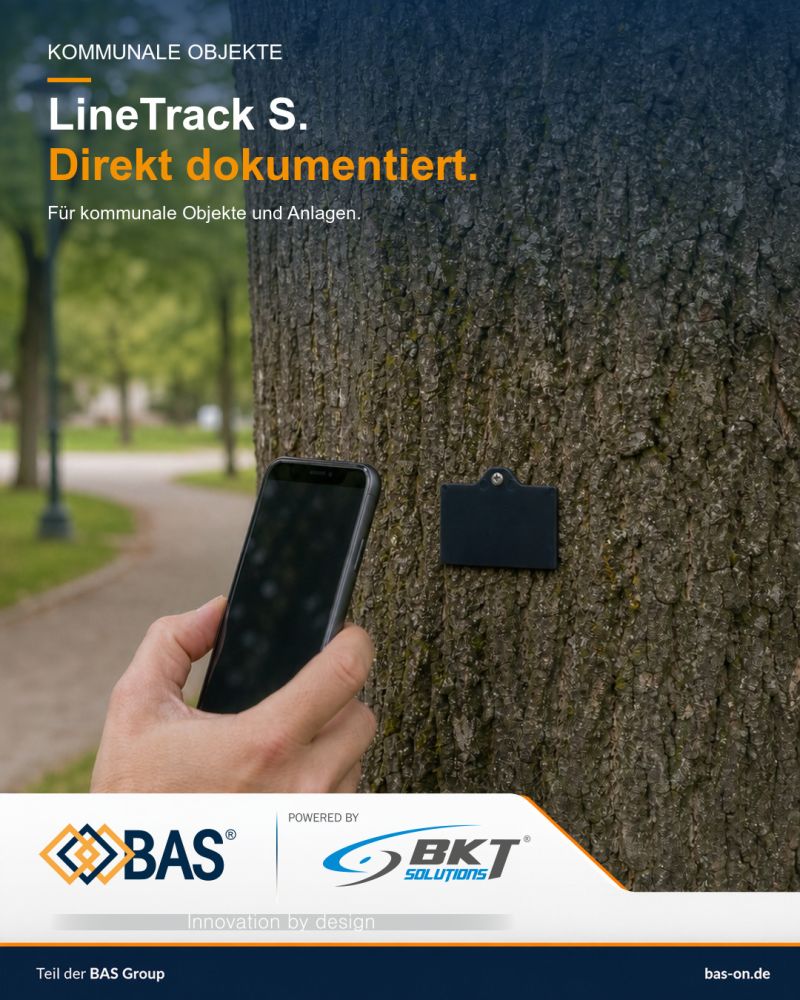
At first glance, a tree, a patch panel, and a microduct seem to have little in common.
As stated in the documentation: Every object must be uniquely identified, located, and linked to the correct information.
There are many types of digital labels. That’s why LineTrack isn’t just a single marker for us, but a family of products designed for various mounting and application scenarios:
LineTrack S can be glued, screwed in, or secured through the top opening—for example, on municipal assets, enclosures, or machines.
LineTrack P adds a visible label or a QR code to a patch panel.
LineTrack U can be attached using cable ties.
LineTrack L and XL are mounted on pipes, microduct assemblies, or other suitable components.
The solution involves more than just hardware. Anyone can download the NexGenPro app and access the object via NFC. Photos, comments, forms, checklists, and documents are directly assigned to it.
Maintenance and service calls can also be documented directly on the LineTrack and uniquely assigned to the respective object. Through the backend, administrators can centrally plan, control, manage, and track these processes at any time.
LineTracks are managed in the cloud backend or, upon request, via a custom backend integrated into the company’s environment.
This creates a seamless system for documentation, maintenance, and service—from municipal tree registries to buildings and technical facilities to telecommunications infrastructure.
Where would such property-specific documentation be most valuable to you: for municipal properties, in buildings, in industry, or in network operations?
Further Information
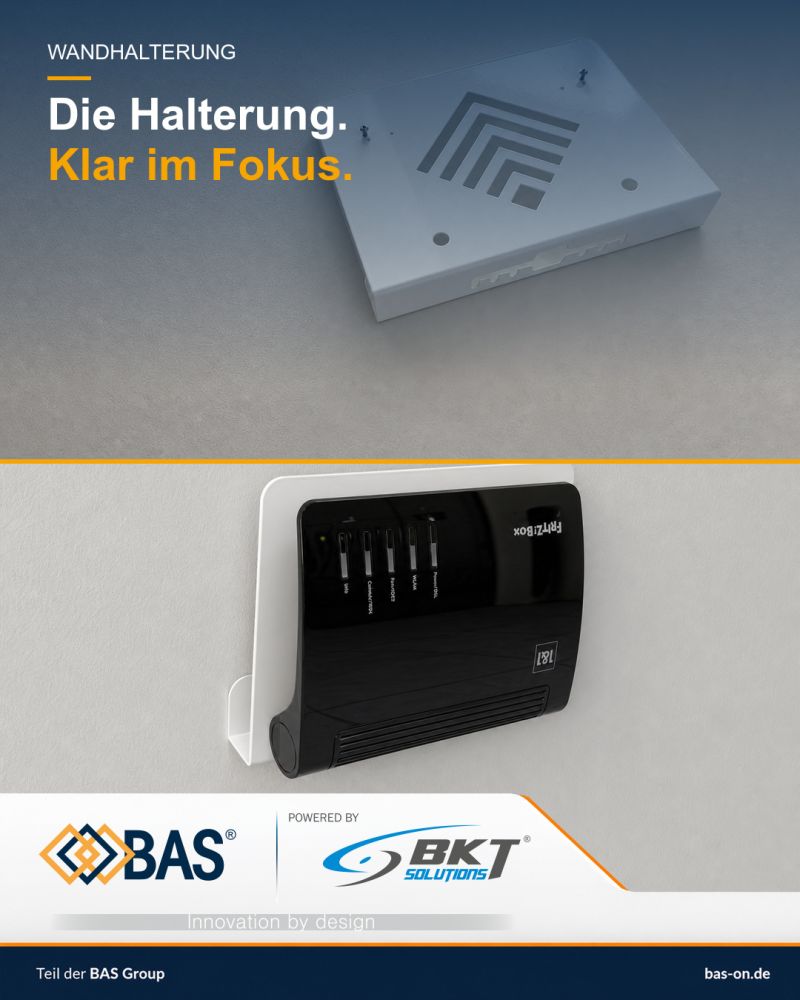
The FRITZ!Box also works when placed on a shelf by itself.
However, this doesn’t make the equipment room any more organized.
Devices, power supplies, patch cords, fiber-optic cables, and excess cable length all need a designated spot—without covering any ports or function buttons and without unnecessarily complicating future maintenance.
BAS has therefore developed two mounts for different installation scenarios:
The 19-inch rack insert accommodates most AVM FRITZ!Box models in a single height unit. The device is secured using the base plate and a clamp or Velcro strap. Connection cables can be routed through the front on the right or left and remain in place thanks to the cable management guide, even when the rack insert is pulled out.
The wall mount provides a compact alternative outside the rack. Openings on the back facilitate heat dissipation. At the same time, it creates space to neatly store excess cable length and other accessories behind the FRITZ!Box.
Both options keep the function buttons accessible and transform a makeshift storage area into a designated installation space.
What most often causes unnecessary hassle in your equipment rooms: lack of space, loose excess cables, or poor access during service?
Further Information
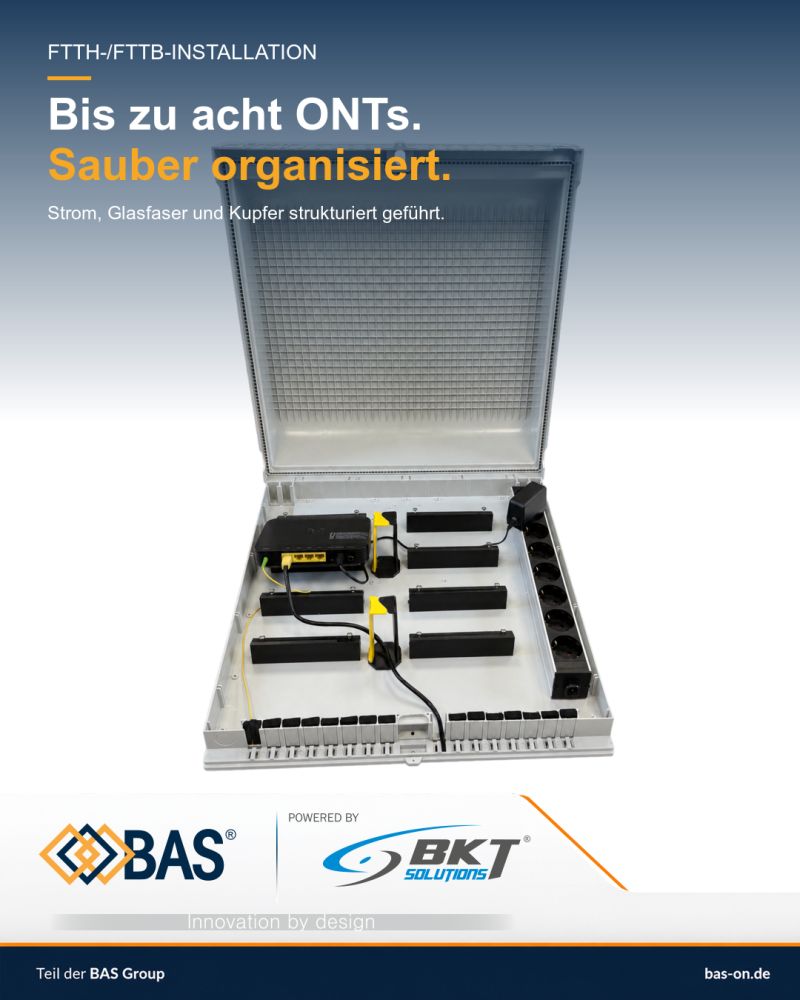
Eight ONTs, the corresponding power supplies ...
Eight ONTs, their corresponding power supplies, and multiple cable runs: In a building distribution frame, what starts as a neat installation can quickly turn into a maze.
It becomes clear—at the latest when expanding the system or performing maintenance—whether active network equipment has merely been crammed in or truly organized. Power, fiber-optic, and copper cables must be clearly routed—and every device must remain accessible without unnecessarily interfering with existing connections.
That’s exactly what the ONT Distribution Box (ODB-8) is designed for:
• Space for up to eight ONTs or routers
• Integrated power strip and mounting for power supplies
• Separate cable routes for power and data cables
• Quick access for replacement, expansion, and maintenance
The compact plastic enclosure is suitable for applications including FTTH/FTTB networks, apartment buildings, building distribution panels, and technical and utility rooms. Depending on the model, it is available in IP40 or IP54 ratings and can be daisy-chained with additional enclosures.
Which task currently takes your installation team the most time in the building distribution panel: assigning power supplies, tracing cables, or replacing devices?
Further Information
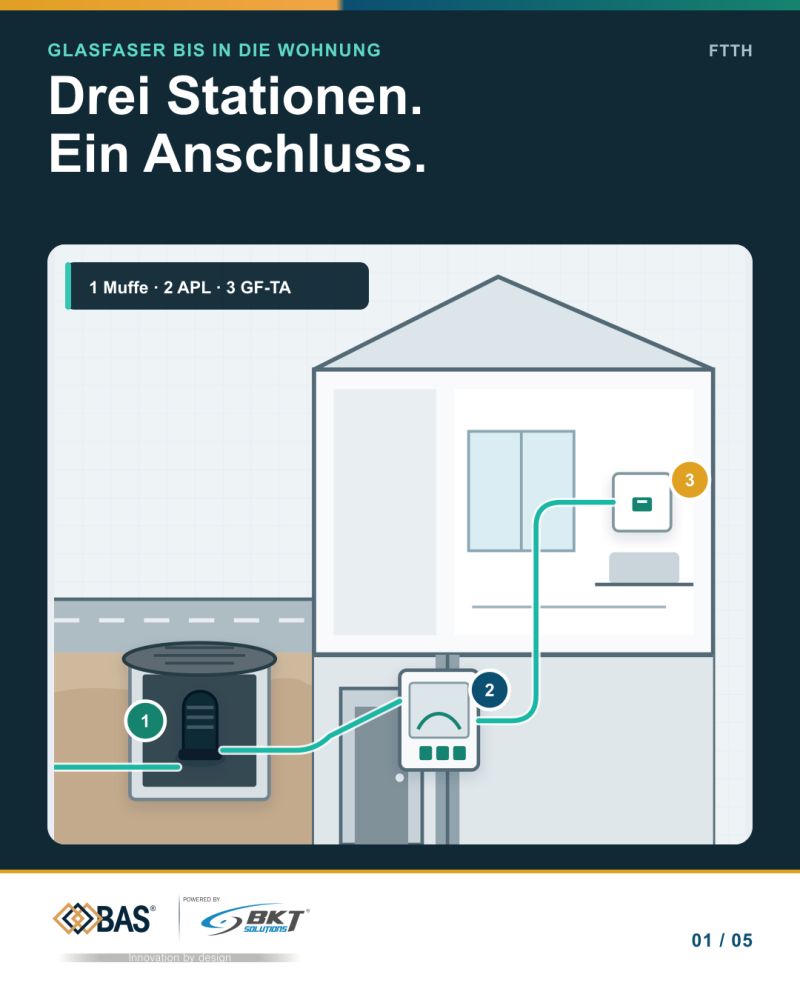
The fiber-optic connection on the living room wall ...
The crucial path to that goal begins out in the network.
Along the distribution network, the HomeRunPlus® fiber-optic splice closure protects sensitive connections and fiber reserves from moisture, dirt, and mechanical stress.
At the building, the FLINC APL creates a clear handoff point: This is where the network operator’s infrastructure ends and the building’s internal cabling begins.
Inside the apartment or unit, the FLINC GF-TA finally makes the connection accessible—for the end device or further internal cabling.
The splice closure, APL, and GF-TA are therefore not three variations of the same box. They are three successive stations along the path to the connection.
A stable connection begins long before the router.
Further Information
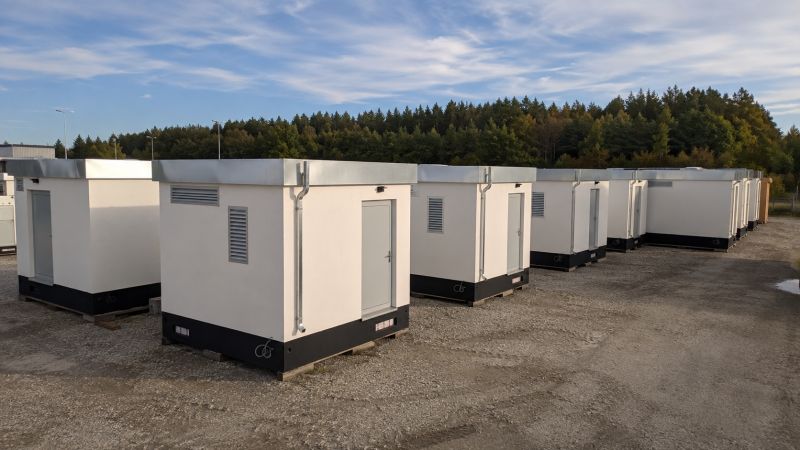
Just because production is complete doesn't mean we've reached our goal.
After all, between the warehouse and the eventual installation site lies a crucial part of every infrastructure project: rollout logistics.
It ensures that a fully prepared system is loaded at the agreed-upon time, reaches its destination safely, and is placed exactly where it’s supposed to be.
Our photos illustrate this process using a concrete example: A PoP leaves the BAS warehouse, embarks on its journey, and is installed on site with the help of a crane.
At BAS, products and system solutions are not only manufactured and stored across more than 75,000 m² of production and warehouse space. Preparation, transport, and delivery must also align with the workflow of each project—whether for PoPs, MFGs, or TerraSecurePlus® network distributors.
Effective rollout logistics usually remain behind the scenes. In these photos, they become visible—from the warehouse to their permanent location on-site.